Evaluating AI for high-stakes work
How teams can apply a consistent framework to review AI outputs
Key Things Covered
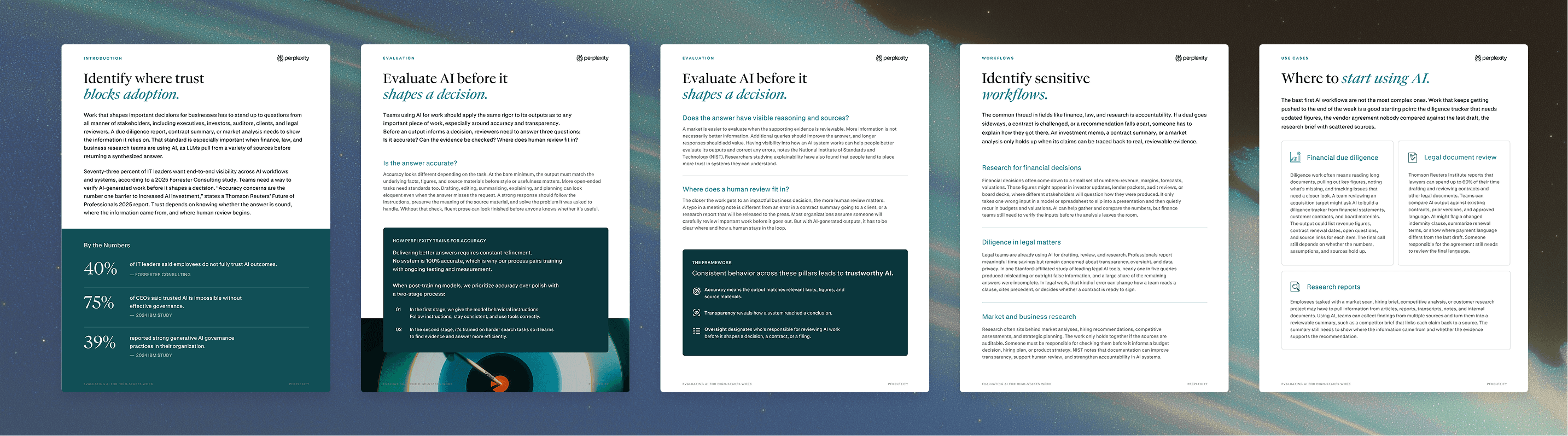
Know why trust blocks adoption
Understand why accuracy is the number one barrier to AI investment, and why finance, legal, and research teams need a way to verify AI work before it shapes a decision.
Apply a framework built for scrutiny
Use three pillars, accuracy, transparency, and oversight, to judge whether an answer matches the facts, shows its sources, and passes through human review before it counts.
Pinpoint the workflows that carry risk
Identify where accountability lives, from investment memos and contract summaries to market analyses, and put the right checkpoints on the work that has to hold up.
Start with the work worth automating
Begin with the tasks that keep getting pushed to Friday, diligence trackers, contract comparisons, and research briefs, then compare AI output against an example the team already trusts.
Summary
Work that shapes important decisions has always had to stand up to scrutiny from executives, investors, auditors, and legal reviewers. AI raises the stakes by synthesizing answers from many sources at once.
This report gives teams a framework for trusting AI output through three pillars: accuracy, transparency, and oversight. Teams learn how to verify that an answer matches the underlying facts, trace every claim back to a reviewable source, and set a clear point where a person signs off before the work informs a decision, a contract, or a filing. Faster output still has to survive the same review, and this guide shows how to hold that standard.